



Positive Coaching in Sport

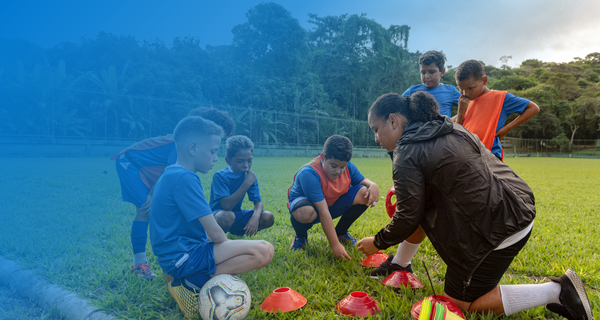
The Positive Coaching in Sport course equips youth sport coaches with an innovative, athlete-centred methodology focused on inclusion, non-discrimination, mentoring, and positive role-modelling.

It aims to create a safe, supportive, and enjoyable sports environment, helping to prevent athlete dropout, promote well-being, and reduce barriers for children at risk of social exclusion.

Certifiers:

University G. d'Annunzio of Chieti-Pescara
Sport Innovation Hub
Montenegrin Olympic Committee
Center for the Affirmation of Youth and Sport

Course description

Throughout this course, you will be introduced to the core principles, strategies, and real-world applications of positive coaching in sport. The learning experience is designed to be interactive, reflective, and practice-oriented, allowing you to connect theory with your own coaching context.
  • The main goals of this course are the following ones:
  • To provide youth coaches with an innovative coaching methodology focused on pedagogy.
  • To promote non-discrimination, inclusion and equality in sport.
  • To encourage the coach’s role as a role model and mentor.
  • To make sport a more positive and enjoyable experience for all athletes.
  • To prevent sport drop-out, especially in situations related to abuse.
  • To protect and enhance athletes’ well-being (both physical and psychological).
  • To reduce barriers to participation for children at risk of social exclusion.
  • To develop coaches who apply reflective practice and continuous improvement in their work.
By the end of the course, you will have developed the skills and confidence to implement a positive coaching framework that prioritises respect, inclusion, motivation, and holistic athlete development. Ultimately, this course aims to support coaches in creating safe, enjoyable, and meaningful sport experiences, contributing to a healthier and more sustainable future for sport at all levels. Funded by the European Union. Views and opinions expressed are however those of the author(s) only and do not necessarily reflect those of the European Union or the European Education and Culture Executive Agency (EACEA). Neither the European Union nor EACEA can be held responsible for them. Co-funded by the European Union

Throughout this course, you will be introduced to the core principles, strategies, and real-world applications of positive coaching in sport. The learning experience is designed to be interactive, reflective, and practice-oriented, allowing you to connect theory with your own coaching context.

  • The main goals of this course are the following ones:
  • To provide youth coaches with an innovative coaching methodology focused on pedagogy.
  • To promote non-discrimination, inclusion and equality in sport.
  • To encourage the coach’s role as a role model and mentor.
  • To make sport a more positive and enjoyable experience for all athletes.
  • To prevent sport drop-out, especially in situations related to abuse.
  • To protect and enhance athletes’ well-being (both physical and psychological).
  • To reduce barriers to participation for children at risk of social exclusion.
  • To develop coaches who apply reflective practice and continuous improvement in their work.

By the end of the course, you will have developed the skills and confidence to implement a positive coaching framework that prioritises respect, inclusion, motivation, and holistic athlete development.

Ultimately, this course aims to support coaches in creating safe, enjoyable, and meaningful sport experiences, contributing to a healthier and more sustainable future for sport at all levels.

Funded by the European Union. Views and opinions expressed are however those of the author(s) only and do not necessarily reflect those of the European Union or the European Education and Culture Executive Agency (EACEA). Neither the European Union nor EACEA can be held responsible for them.

Co-funded by the European Union

Need more info?

Add text related to the form more information requesting.

Fee:

0

Length

5 hours

Credits

0.5

Starting date

14 Apr 2025

Modules:

5

Languages:

EN

Courses you may like

Start advancing your career now.
Free

This microcredential (0.3 ECTS · 3 hours) studies how mental processes and behaviour influence sporting performance, and how this performance, in turn, influences the psychological wellbeing of the individual taking part. This course offers a practical introduction to the fundamental concepts of sport psychology, designed for coaches, sports trainers and athletes who wish to understand and apply these tools in their day-to-day lives, without the need for prior knowledge of psychology.

Sport Academy
Free

This microcredential (0.3 ECTS · 3 hours) is built for anyone who works, or wants to work, with athletes and needs a solid, up-to-date foundation in applied nutrition. The course starts from the fundamental concepts of food and nutrition and connects them, module by module, to the decisions a coach, trainer, or rehabilitation professional makes every day: which foods to recommend, how much energy an athlete needs, how to distribute carbohydrate, fat, and protein, which vitamins and minerals matter most in sport, how to plan hydration, and what the evidence says about the most common ergogenic aids (caffeine, creatine, sodium bicarbonate, nitrate).

Sport Academy
Free
Discover how to integrate sustainability into the coaching of sport teams through a practical and comprehensive approach. This course provides key knowledge based on the SDG indicators, covering topics such as carbon footprint, circular economy, and resource management. It also includes ESG criteria, regulatory frameworks, and practical recommendations supported by real-life examples.
ICSS Europe
Free
Discover how to integrate sustainability into the management of sports organisations through a practical and comprehensive approach. This course provides key knowledge based on the SDG indicators, covering topics such as carbon footprint, circular economy, and resource management. It also includes ESG criteria, regulatory frameworks, and practical recommendations supported by real-life examples.
ICSS Europe
View all Courses